Lift Kit Alignment in Mesquite TX for Trucks
After a lift kit installation, your truck needs proper alignment to handle safely. We explain what happens to your suspension geometry and how we set it right in Mesquite.
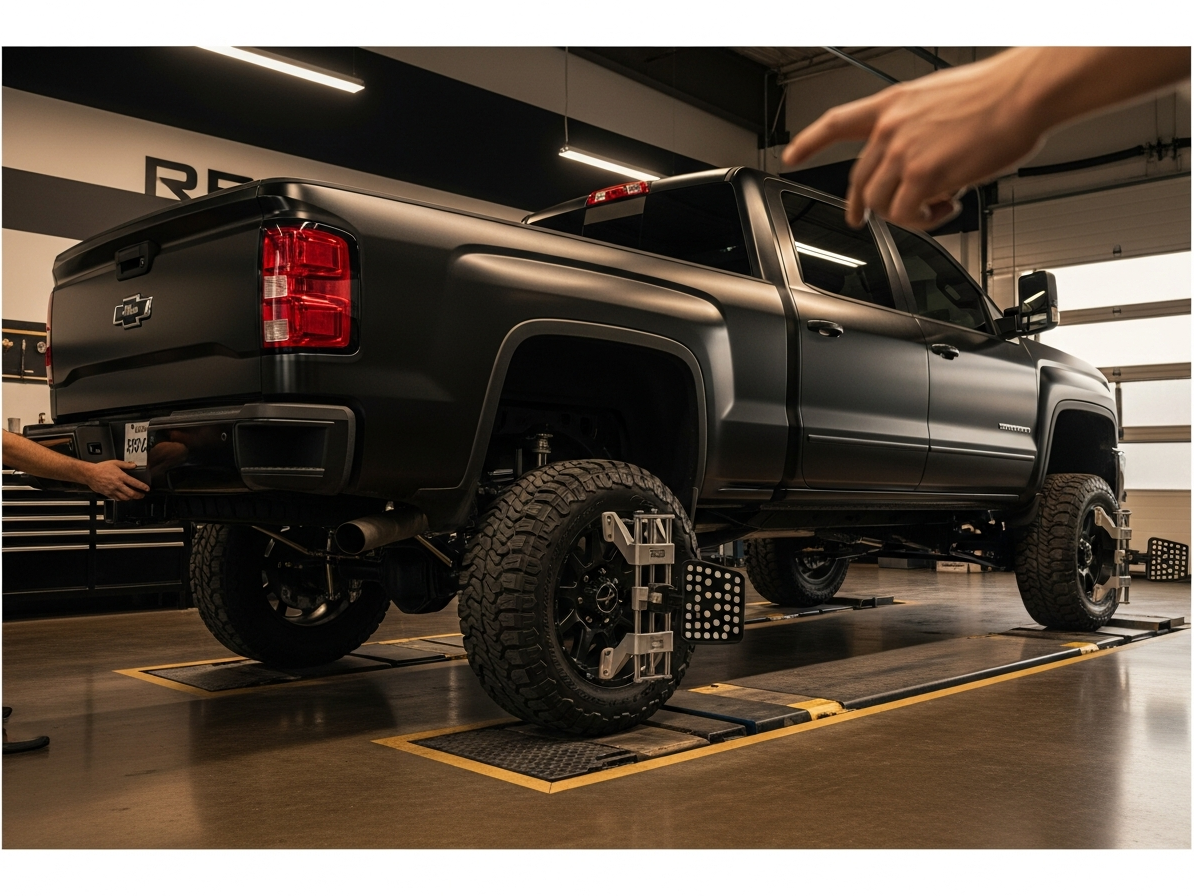
A lift kit changes more than how your truck looks. It changes how every component in your suspension geometry relates to each other the moment the installer bolts those blocks or a-arms into place. If you drive a lifted truck in Mesquite or anywhere across Dallas County, you need to know what that means for your alignment.
Stock suspension sits at specific angles designed by the manufacturer. Those angles govern how your tires contact the road, how your steering feels, and how evenly your components wear. A lift raises the vehicle and pulls those angles out of spec. Camber goes out and your front wheels may tilt inward or outward at the top. Caster shifts, which affects high-speed stability and steering return. Toe angles change, usually pushing your tires toward each other or apart. On four-wheel-drive trucks the driveshaft angle changes too, which can cause vibration at certain speeds. Every one of these shifts is predictable and measurable, which means every one can be corrected.
Beyond tire wear, bad alignment after a lift puts stress on components that were not designed for it. Ball joints, tie rods, and control arm bushings all wear faster. On four-wheel-drive trucks, the transfer case and differentials can experience additional stress from incorrect driveshaft angles. Correct alignment extends the life of your suspension parts, keeps your brakes working evenly, and keeps your steering responsive and predictable. On a lifted truck that sits higher and weighs more in the front end, predictability matters even more than it does on a stock vehicle.
When you bring your lifted truck to us in Mesquite, we start by measuring everything: camber, caster, toe, and on four-wheel-drive trucks, the driveshaft angle. We compare your current measurements to the specs that apply to your specific lift kit and vehicle combination, because there is no generic number for a lifted truck. The spec depends on the lift height and the manufacturer. We adjust what can be adjusted. Most lifts require aftermarket camber bolts, offset ball joints, or adjustable tie rod ends to bring things into range, and if your truck has adjustable upper control arms we set those to the correct geometry for your lift height.
The alignment itself usually takes about an hour once we are on the lift. If we find worn components that need replacement first, we tell you what we found, give you the cost in writing, and wait for your approval before touching anything. We do not surprise you with add-ons when you are picking up the truck. We back our alignment work with our 24-month or 24,000-mile workmanship warranty, so if something shifts within that window because of how we set it, we fix it.
Come by at 4036 I-30 Frontage Road in Mesquite, give us a call at (888) 348-4808, or book an appointment online. We give you a straight written estimate before any work begins. If you are not sure whether your lifted truck needs alignment, bring it by and we will measure it. There is no charge for the check.
Signs your lifted truck needs alignment
- Uneven tire wear on the inside or outside shoulder
- The steering wheel sits off center when driving straight
- The steering wheel vibrates or shakes at highway speeds
- The vehicle pulls to one side or the other
- Squeaking or popping from the front end on turns
- Excessive play in the steering wheel